Ayurvedic Third-Party Manufacturing | Inbiota Herbs
The global demand for natural, botanical, and wellness products has created unprecedented opportunities for health brands. Entering the herbal market through Ayurvedic third-party manufacturing allows businesses to launch and scale their product lines without investing heavily in their own production infrastructure. However, manufacturing herbal and classical Ayurvedic formulations involves unique considerations that differ significantly from standard modern pharmaceuticals or food products.
Selecting a manufacturing partner requires evaluating a complex set of operational, regulatory, commercial, and technical variables. Every botanical ingredient, liquid extract, and powder formulation carries distinct handling requirements, stability traits, and processing parameters. To build a resilient brand and ensure consistent product quality, business owners must ask precise, category-specific questions before committing to a manufacturing contract.
Businesses looking to establish or expand their presence in the herbal market often collaborate with experienced manufacturing partners like Inbiota Herbs to streamline production, maintain quality consistency, and navigate technical specifications effectively.
What Is Ayurvedic Third-Party Manufacturing?
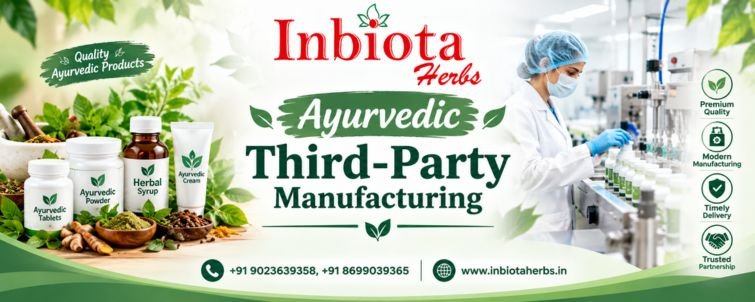
At its core, Ayurvedic third-party manufacturing—also referred to as third-party Ayurvedic manufacturing or contract manufacturing—is a business arrangement where a brand owner hires an external Ayurvedic products manufacturer to formulate, process, package, and label products under the brand’s own registered name.
Division of Responsibilities
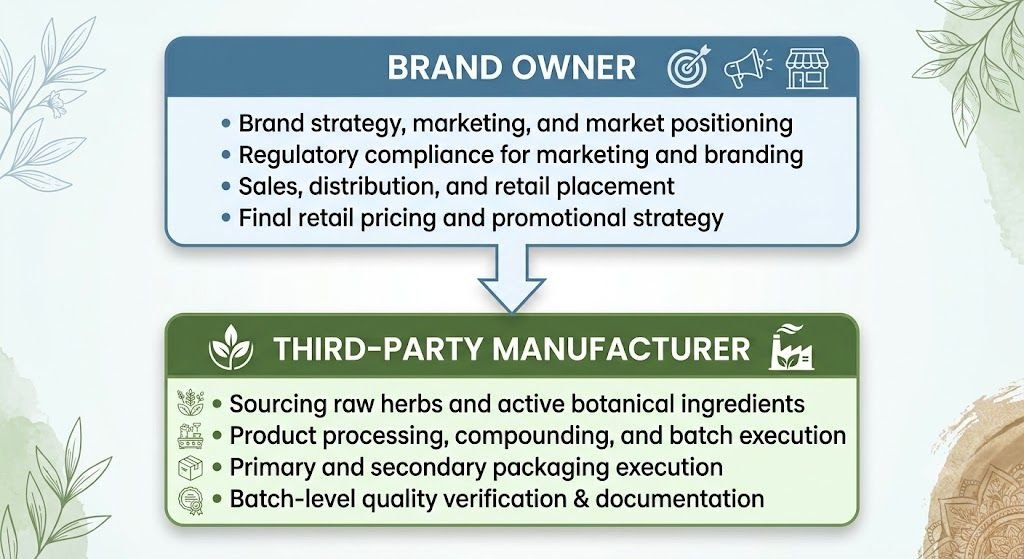
In a typical third-party model, responsibilities are clearly split between the brand owner and the manufacturing partner:
Strategic Benefits for Brand Growth
Outsourcing production offers several commercial and operational advantages:
- Capital Efficiency: Eliminates the immense capital expenditure needed to set up processing units, maintain specialized equipment, and hire technical plant staff.
- Rapid Market Entry: Allows brands to launch market-ready herbal lines significantly faster by leveraging established production lines.
- Operational Focus: Frees up internal resources so brand teams can focus entirely on sales, marketing, distributor networking, and customer acquisition.
- Scalability: Enables brands to scale batch sizes up or down based on seasonal demand fluctuations without bearing fixed factory overheads.
Why Are Category-Specific Questions Important?
herbal and classical products cannot be treated like synthetic tablets or simple consumer packaged goods. Natural ingredients possess inherent variability due to seasonal harvesting, geographic origin, and processing methods. Consequently, partnering with an Ayurvedic manufacturing company requires a specialized evaluation process.
Category-specific questions are essential because of:
- Ingredient Behavior: Raw botanicals, herbal extracts, and essential oils respond differently to heat, humidity, and compression during processing.
- Formulation Complexity: Multi-herb synergistic formulations require precise ratio controls to maintain consistency across batch cycles.
- Packaging Compatibility: Herbal oils and liquid decoctions can react with improper container materials, leading to leakage, discoloration, or degradation.
- Documentation Rigor: Complete traceability from raw herb procurement to final batch discharge is mandatory to fulfill commercial and distribution standards.
By asking focused questions early, brand owners mitigate supply chain risks, prevent costly product recalls, and ensure their products align with expected commercial standards.
What Ayurvedic Products Can Be Manufactured Through Third-Party Manufacturing?
Modern contract processing units handle a broad spectrum of classical and proprietary botanical product formats. Depending on a manufacturer’s facility capabilities and technological setup, brands can contract production across multiple dosage forms.
| Product Category | Common Dosage Formats | Key Manufacturing Considerations |
| Solid Oral Dosages | Compressed Tablets, Coated Tablets, Hard Gelatin/Vegetarian Capsules | Granulation characteristics, moisture sensitivity, disintegration times. |
| Liquid Orals | Herbal Syrups, Decoctions (Khashaya), Suspensions | Viscosity control, sugar/sweetener solubility, shelf-life stability. |
| Powder Formulations | Granules, Classical Powders (Churna) | Particle size distribution, moisture barrier packaging, flowability. |
| Topical & Oils | Herbal Oils (Taila), Serums, Creams, Ointments | Base oil processing, emulsion stability, viscosity, aroma retention. |
| Personal Care | Herbal Shampoos, Soaps, Face Washes, Gels | Surfactant balance, pH compatibility, natural active preservation. |
Evaluating a partner’s portfolio helps brands determine if a manufacturer can handle immediate product requirements as well as future product line extensions. Partners like Inbiota Herbs work closely with business clients to determine which dosage formats best suit their target market and product positioning.
Essential Questions to Ask an Ayurvedic Third-Party Manufacturer
When evaluating potential manufacturing partners, brand owners should structure their inquiries around operational, technical, and commercial capabilities. Here are the crucial questions to ask:
1. Product Capabilities & Customization
- What specific dosage forms do you specialize in?
- Verify whether their primary experience lies in liquids, solid oral dosages, topicals, or specialized herbal powders.
- Can you manufacture custom formulations based on our specific requirements?
- Determine whether the plant only offers standard catalog formulations or if they can execute custom developer formulas.
- How do you handle formulation variations and dosage adjustments?
- Understand their technical approach when adjusting active botanical proportions or excipient bases.
2. Raw Materials & Sourcing
- What standards are used to source and inspect raw herbs?
- Inquire about physical identification, moisture testing, and purity checks performed on incoming raw materials.
- Do you work with standardized herbal extracts, raw herbs, or both?
- Standardized extracts ensure consistent concentration of active botanical compounds, whereas raw powders offer traditional profile characteristics.
3. Packaging & Technical Specifications
- What primary and secondary packaging options do you provide?
- Ask about PET bottles, glass containers, blister packs, strip packs, composite jars, and outer carton configurations.
- Can you accommodate custom container sizes and designs?
- Ensure their filling and labelling machinery can handle your unique bottle shapes or custom box dimensions.
4. Commercial & Operational Terms
- What are your Minimum Order Quantities (MOQs) per batch?
- Clarify the minimum units required per production run for each product format.
- What is the standard production lead time from order placement to dispatch?
- Establish baseline timelines for repeat orders as well as initial production runs.
- What exact documentation accompanies each completed batch?
- Confirm whether Certificate of Analysis (COA), batch manufacturing records, and invoice details are routinely provided.
How Does Product Formulation Matter in Ayurvedic Manufacturing?
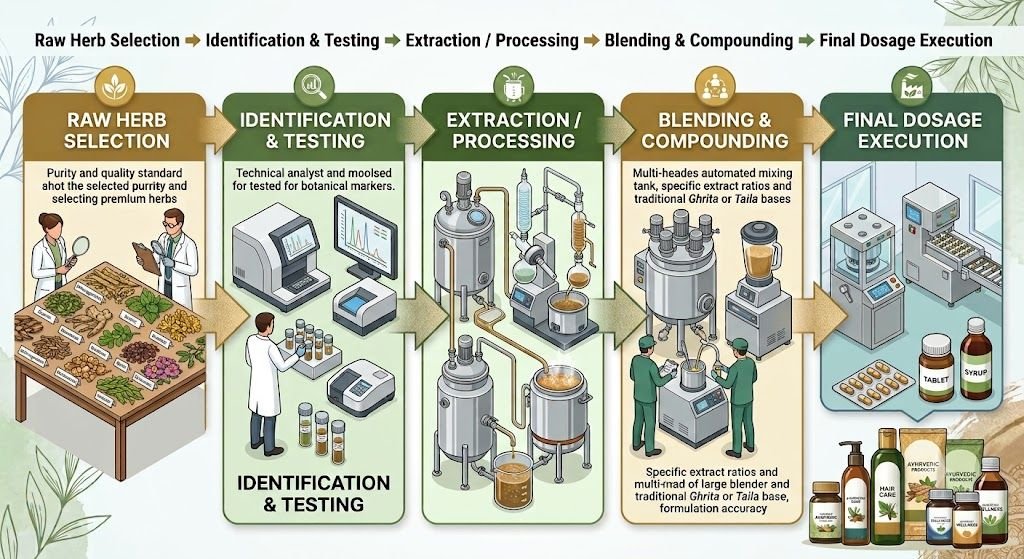
Formulation stability and batch-to-batch consistency are the most critical factors in Ayurvedic product manufacturing. Unlike synthetic chemical compounds that remain uniform, botanical raw materials vary based on harvest season, soil conditions, and drying techniques.
Key Considerations for Formulation Success
- Ingredient Identification: Raw herbs must undergo rigorous visual, physical, and botanical verification to prevent adulteration or species confusion.
- Physical Consistency: Herbal powders must maintain uniform particle sizing, while liquid extracts must demonstrate stable viscosity and pH levels.
- Excipient Integration: Selecting appropriate natural or approved excipients ensures tablets hold structural integrity without compromising disintegration rates.
- Clear Communication: Brand owners must clearly state whether they require classical traditional methods or modernized botanical extract formulations.
Clear communication with your Ayurvedic contract manufacturing partner during the initial batch trial ensures that physical parameters—such as color, taste, texture, and aroma—remain consistent across every commercial order.
What Should You Know About Packaging and Labelling?
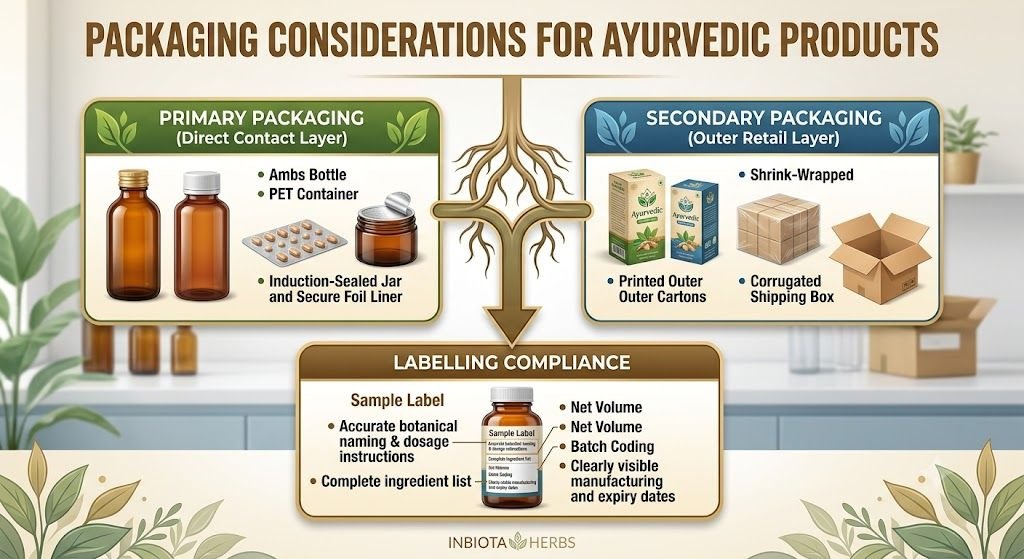
Packaging serves two primary roles: protecting sensitive botanical active ingredients from atmospheric degradation and communicating brand identity on retail shelves.
Packaging Material Selection
Herbal oils, tinctures, and liquid decoctions often contain light-sensitive botanical actives. Using amber-colored PET or glass containers prevents photo-degradation. Similarly, moisture-sensitive herbal extracts require high-barrier blister materials or induction-sealed HDPE containers.
Regulatory & Labeling Coordination
Labeling for herbal and traditional products must strictly follow regional commercial guidelines. Outer packaging must display accurate botanical names, net quantities, manufacturing license numbers, batch numbers, manufacturing dates, expiry dates, and complete usage instructions. Discussing packaging specifications prior to placing production orders avoids costly re-printing or delivery delays.
Evaluating Production Capacity and Order Requirements
Understanding a manufacturer’s capacity helps brand owners plan inventory, manage working capital, and scale smoothly as market demand grows.
Understanding Minimum Order Quantities (MOQs)
Every Ayurvedic manufacturing company sets MOQs based on machine setup times, raw material purchasing thresholds, and wash-down procedures required between product batches.
- Initial Trial Runs: Smaller MOQs lower market entry barriers for new brand launches.
- Commercial Scale Runs: Larger MOQs reduce the unit cost per item, improving retail profit margins.
Managing Production Timelines and Repeat Orders
Production timelines encompass several stages:
TotalProductionLeadTime=RawMaterialSourcing+BatchProcessing+Packaging+QualityVerificationTotal Production Lead Time = Raw Material Sourcing + Batch Processing + Packaging + Quality Verification
Brand owners should align their commercial launch schedules with realistic lead times. Establishing clear re-order thresholds prevents stock-outs during peak sales periods. Selecting an established third-party Ayurvedic manufacturing partner guarantees scalable processing lines capable of accommodating sudden spikes in order volume.
Crucial Documentation Needed Before Placing an Order
Transparent documentation guarantees product traceability and establishes clear accountability between the brand and the contract producer. Prior to issuing a commercial purchase order, review the following documentation requirements:
- Product Specification Sheets: Outlines the physical, chemical, and organoleptic properties of the finished product.
- Certificate of Analysis (COA): A detailed test report accompanying every batch confirming parameters like pH, specific gravity, viscosity, and heavy metal limits.
- Batch Manufacturing Records (BMR): Internal production logs documenting step-by-step processing parameters and raw material lot numbers used.
- Commercial Invoices & Packing Lists: Detailed dispatch documents outlining itemized product counts, batch numbers, and net weights for logistics tracking.
Working with an Ayurvedic product manufacturer in India that provides complete batch-level documentation ensures your brand maintains full traceability from farm to pharmacy shelf.
How Inbiota Herbs Supports Third-Party Manufacturing Needs
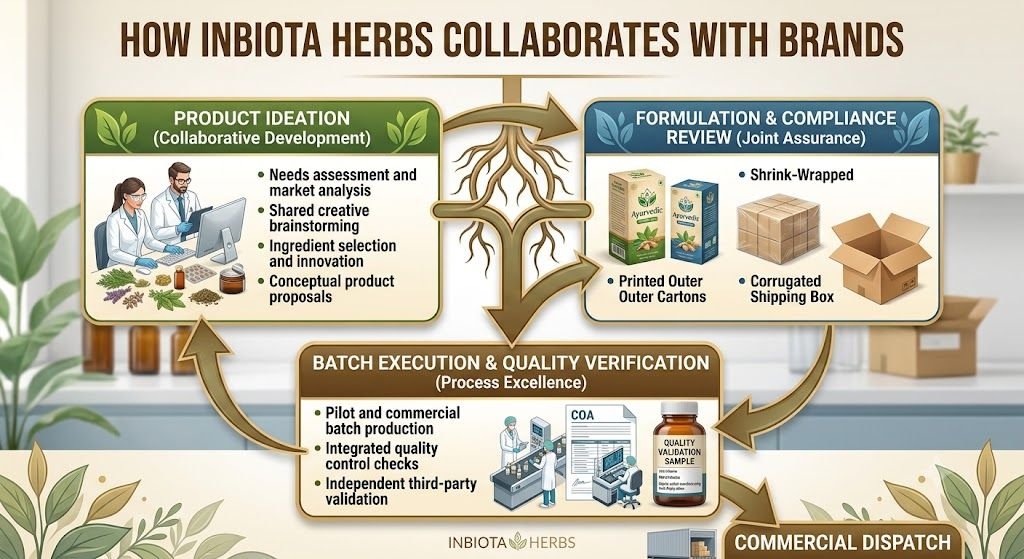
Finding a dependable, transparent, and technically capable contract partner is essential for sustainable growth in the herbal wellness industry. Inbiota Herbs provides structured Ayurvedic third-party manufacturing support designed to simplify product execution for emerging and established health brands.
Key Operational Strengths of Inbiota Herbs
- Diverse Product Capability: Capabilities covering solid oral forms, herbal liquids, traditional powders, topical oils, and personal care formulations.
- Tailored Manufacturing Support: Flexible batch capabilities tailored to meet specific brand requirements and order volumes.
- Packaging Solutions: Assistance with primary container selection, closure integrity, and outer packaging layout coordination.
- Transparent Communication: Clear, upfront discussions regarding lead times, documentation, and pricing structures.
By acting as a dedicated operational partner, Inbiota Herbs allows brand leaders to concentrate on marketing, brand positioning, and customer acquisition while production processing is managed with technical precision.
Pre-Selection Checklist for Manufacturing Partners
Before signing a manufacturing contract or issuing an advance deposit, complete this evaluation checklist:
- [ ] Product Range Alignment: Does the manufacturer specialize in your specific required dosage form (tablets, liquids, powders, oils)?
- [ ] Formulation Clarity: Are the ingredient ratios, base selections, and product specs clearly defined in writing?
- [ ] Raw Material Quality: Has the manufacturer explained their sourcing and quality verification procedures for raw herbs?
- [ ] MOQ Compatibility: Do their Minimum Order Quantities align with your current inventory budget and sales forecasts?
- [ ] Transparent Pricing: Is the cost breakdown clear regarding raw materials, processing, primary packaging, and outer cartons?
- [ ] Packaging Versatility: Are container options compatible with your product’s physical stability requirements?
- [ ] Documentation Provision: Does the partner provide batch-level COAs and complete product specification sheets?
- [ ] Realistic Timelines: Is the stated lead time from raw material procurement to final dispatch practical for your business plan?
- [ ] Scalability Potential: Can the production plant accommodate a 2x or 5x increase in order volume as your brand expands?
- [ ] Communication & Responsiveness: Does the account manager communicate clearly, directly, and in a timely manner?
Conclusion
Choosing the right production partner is one of the most critical decisions an herbal brand owner will make. Ayurvedic third-party manufacturing offers an efficient, cost-effective pathway to enter and scale within the wellness market, provided you ask the right category-specific questions early in the evaluation process.
By assessing formulation handling, ingredient quality, packaging compatibility, MOQs, production timelines, and batch documentation, brands build resilient supply chains and safeguard their market reputation. Partnering with a supportive and communicative contract manager like Inbiota Herbs ensures your brand receives reliable manufacturing support, clear documentation, and consistent product execution across every batch run.
Are you preparing to launch a new product line or scale your existing herbal product portfolio? Contact the team at Inbiota Herbs today to discuss your manufacturing specifications, request product catalog details, and explore custom third-party manufacturing solutions tailored to your business goals.
Frequently Asked Questions (FAQs)
1. What is Ayurvedic third-party manufacturing and how does it work?
Ayurvedic third-party manufacturing is a commercial arrangement where a brand owner contracts an external manufacturer to formulate, process, package, and label Ayurvedic products under the brand’s own name. The manufacturer handles raw material sourcing, processing, and batch production, while the brand owner focuses on marketing, distribution, sales, and brand growth.
2. What questions should I ask an Ayurvedic third-party manufacturer before placing an order?
Before signing an agreement, ask about their specific dosage form capabilities, minimum order quantities (MOQs), raw material inspection standards, custom formulation flexibility, primary and secondary packaging options, standard production lead times, and the batch documentation (such as Certificates of Analysis) provided with each dispatch.
3. How do minimum order quantities (MOQs) work in third-party Ayurvedic manufacturing?
Minimum Order Quantities (MOQs) represent the minimum number of units a manufacturer requires per production run to cover machinery setup, line wash-downs, and raw material sourcing costs. MOQs vary depending on the product format—for example, liquids, tablets, capsules, and oils each have different operational setup requirements.
4. Can an Ayurvedic third-party manufacturing partner customize formulations for my brand?
Yes, many third-party Ayurvedic manufacturers support custom product requirements. Depending on your target market, you can work with the manufacturing partner to adjust active botanical proportions, choose specific herbal extract ratios, or select base excipients that fit your product positioning.
5. How can Inbiota Herbs support my Ayurvedic product manufacturing requirements?
Inbiota Herbs provides comprehensive Ayurvedic third-party manufacturing support across multiple dosage forms, including tablets, capsules, syrups, powders, topical oils, and personal care formulations. Inbiota Herbs assists brand owners with flexible batch execution, packaging coordination, clear communication, and full batch documentation to ensure consistent product delivery.